
De Planctu Naturae (c. 1200 CE)
A 12th-century allegorical prosimetrum in which personified Nature laments humanity's deviation from divine order, particularly focusing on sexual transgression and moral corruption. This sophisticated blend of Platonic cosmology and Christian ethics became influential in medieval literature for its personification of Nature as God's deputy and its treatment of natural law.
Historical Context
Authorship: De Planctu Naturae (The Complaint of Nature) is generally accepted as an authentic work of Alanus de Insulis (Alan of Lille). Medieval sources and modern scholars alike attribute it to Alan – there is no serious doubt about his authorship (www.newadvent.org). Earlier editors included it in Alan’s collected works (e.g. Migne’s Patrologia Latina vol. 210) (www.newadvent.org). However, historians caution that Alan’s biography is often confused with other contemporaries named “Alan” (handwiki.org). For example, Alan of Lille was long conflated with an “Alan, Bishop of Auxerre” and others; modern research has disentangled these identities (handwiki.org). The scholarly consensus today firmly credits De Planctu Naturae to Alan of Lille himself, the 12th-century theologian known as Doctor Universalis (www.newadvent.org).
Date of Composition: Alan of Lille likely wrote De Planctu Naturae in the mid to late 12th century. The text is often dated to the 1160s or 1170s, during Alan’s mature scholarly period. There are no explicit dates in the text, but contextual clues and Alan’s life timeline support this range (www.newadvent.org). By 1179 Alan was prominent enough to attend the Third Lateran Council (www.newadvent.org), and he entered the Cistercian abbey of Cîteaux soon after (www.newadvent.org). Scholars posit that De Planctu Naturae was composed before his monastic retirement (i.e. before c.1180), likely while he was teaching in the schools. In his 1978 critical edition, Nikolaus Häring suggested an early history for the text consistent with the 1170s (www.persee.fr) (www.persee.fr). The work’s sophisticated allegorical style also aligns with the intellectual climate of the mid-1100s, when courtly and scholastic allegory flourished. Thus, a composition date around 1160–1170 is often assumed (though an exact year remains uncertain).
Provenance: The text was probably written in northern France, in the milieu of the cathedral schools. Alan of Lille studied and taught in Paris and perhaps Chartres (handwiki.org), and De Planctu Naturae reflects the scholastic culture of those centers. Some scholars argue Alan may have begun the work in Paris during his professorship (handwiki.org). There is ongoing debate about Alan’s own origins: traditionally “de Insulis” was thought to mean Lille in Flanders, but recent research by Carla Rossi (2009) proposes he was from a Breton isle (possibly the Île de Batz) (journals.openedition.org). If Alan hailed from Brittany, he might have brought a unique perspective to the Parisian school environment. In any case, De Planctu Naturae was likely composed in the scholarly circles of France, under circumstances combining academic learning with literary patronage. The work’s polished Latin and learned allegory suggest it was written for an educated audience at court or school, rather than in monastic seclusion.
Historical Setting: De Planctu Naturae emerged during the 12th-century Renaissance, a time of intellectual vibrancy in Europe. Politically, this was the era of growing universities and royal courts; culturally, Latin writers were blending classical philosophy with Christian thought. Alan lived amid major events – for example, the Third Lateran Council of 1179 (which he attended) addressed Church reform and heresies (www.newadvent.org). The Church in Alan’s day was combatting heterodox movements like the Cathars and Waldensians, and Alan himself wrote anti-heretical works. Meanwhile, scholastic theology was maturing (Peter Lombard died 1160; Thomas Aquinas was born 1225). In literature, French vernacular romance and Latin allegory were thriving side by side. Alan’s De Planctu, with its personification of Nature and poetic prose, fits into this zeitgeist of high medieval allegory. It was roughly contemporary with Bernard Silvestris’ Cosmographia and precedes Jean de Meun’s continuation of the Roman de la Rose; indeed, Alan’s work helped bridge classical traditions and later medieval literature (sourcebooks.web.fordham.edu) (sourcebooks.web.fordham.edu).
Intended Audience: Alan of Lille likely wrote De Planctu Naturae for an educated clerical and courtly audience. The text’s elaborate Latin – mixing verse and prose – indicates a readership of scholars, students, and literate courtiers. It was not a popular sermon or simple moral tract, but rather a sophisticated allegory that presumes knowledge of grammar, rhetoric, and philosophy (dick.wursten.be) (dick.wursten.be). Alan’s immediate audience may have been colleagues or patrons in the scholastic community; for instance, he dedicates other works to popes and bishops (www.newadvent.org). De Planctu itself does not carry a dedication, but its themes (natural law, moral disorder) address concerns shared by church intellectuals of the time. The work functioned in part as didactic literature – a creative way to instruct readers about vice and virtue. Medieval copies often include commentary and glosses, suggesting it was read and taught in school settings (www.persee.fr). In summary, the original audience was the Latin-literate elite of the 12th century, whom Alan sought to edify with an erudite poetic vision of Nature’s “complaint” about human corruption.
Theological Significance
Core Themes: De Planctu Naturae is an allegorical exploration of natural law, morality, and the cosmic order. Its central figure is Natura (Nature personified as a wise noble lady) who laments how humans violate the divinely ordained order of creation (dick.wursten.be) (dick.wursten.be). The text alternates between poetic meters and prose (a Boethian prosimetrum format), as Nature delivers a philosophico-theological monologue. Key themes include the perversion of nature’s gifts, especially through sexual sin – Alan identifies the “root of all evil” as the abuse of sexuality contrary to nature (dick.wursten.be) (dick.wursten.be). In particular, the work famously condemns homosexual acts (sodomy) as an affront to Nature, using elaborate metaphors of grammar and biology to illustrate this disorder (dick.wursten.be) (dick.wursten.be). Alan depicts a universe where everything is interconnected – moral corruption in one sphere (e.g. sexuality) mirrors linguistic and cosmic corruption (dick.wursten.be) (dick.wursten.be). Other themes include the harmony of the created world, the hierarchy of beings, and the necessity of restoring concord with Nature’s laws. Throughout the text, Alan’s language is highly figurative and learned, employing classical allusions and intricate wordplay to convey serious moral lessons (sourcebooks.web.fordham.edu) (sourcebooks.web.fordham.edu).
Patristic Context: Although written in the 12th century, De Planctu Naturae draws on earlier Christian and classical thought. Alan was well-versed in the Church Fathers and Neoplatonic tradition. The concept of “Nature as God’s viceregent” has roots in authors like Augustine and Pseudo-Dionysius. In fact, Alan teaches that God created Nature to be His vicaria (deputy) in governing material creation (www.newadvent.org) (www.newadvent.org) – an idea echoing John Scotus Eriugena and others who fused Christian doctrine with Neoplatonism (www.newadvent.org) (www.newadvent.org). The Complaint of Nature also shows influence from Boethius’ Consolation of Philosophy (Alan imitates its prosimetrical form and personification of abstract entities) (dick.wursten.be). While not citing Scripture explicitly very often, Alan’s moral framework aligns with biblical teachings: for example, the condemnation of “unnatural” vice reflects St. Paul’s epistle to the Romans 1:26-27 on passions “against nature.” He also inherits from patristic writers a categorization of sins (like lust against nature) as especially grievous (dick.wursten.be). Alan’s rational mysticism – the attempt to explain divine order through reason imbued with spiritual insight – can be seen as part of the legacy of Augustine and Gregory the Great, adapted to a scholastic context (www.newadvent.org) (www.newadvent.org). In summary, De Planctu Naturae stands on patristic foundations (natural law, cosmic hierarchy, moral order) while employing the dialectic and allegorical style characteristic of the 12th-century School of Chartres and Paris.
Biblical Foundation: The work is not a biblical commentary, but it rests on a biblical worldview. Alan presumes the Genesis creation order – male and female created by God – in arguing against sins that blur gender distinctions (dick.wursten.be) (dick.wursten.be). Nature’s complaint often aligns with biblical morality: for instance, she inveighs against pride, avarice, and lust, akin to the “works of the flesh” denounced by St. Paul. There are also implicit scriptural references: the lament over humanity’s fall from natural innocence echoes the Fall of Man in Genesis (without explicitly naming Adam and Eve). Additionally, Alan’s personified Nature occasionally speaks like Old Testament Wisdom literature, calling humans back to the right path. One striking passage describes men “making themselves women” by unnatural vice (dick.wursten.be), which recalls the biblical destruction of Sodom (Genesis 19) and Paul’s description of men who “gave up natural relations with women” (Romans 1:27). While De Planctu is richly classical and philosophical in language, its underlying moral code is biblical – Nature’s law is ultimately God’s law, “for God first created Nature as His intermediary” in governing the universe (www.newadvent.org). Alan’s integration of biblical ethics with personified Nature helped pave the way for later thinkers (like Thomas Aquinas) to articulate natural law as harmonious with Scripture.
Controversies: In Alan’s own time, De Planctu Naturae did not spark doctrinal condemnations – its positions are essentially orthodox, though forcefully expressed. However, modern readers note that Alan’s method can be provocative. His extended attack on homosexual behavior (using the metaphor of grammatical gender confusion) has drawn much analysis from modern scholars of gender and sexuality (dick.wursten.be) (dick.wursten.be). While this stance was conventional for a medieval churchman, the explicit metaphorical language he employs – talking of Venus “making men into women” by a “magic art” – is unusually vivid (dick.wursten.be). There is also a minor scholarly debate about the text’s view of language and allegory: some argue Alan verges on a heterodox Neoplatonism by elevating Nature almost to a semi-divine status, or by implying that language itself can become corrupt and thwart divine truth. But generally, Alan stays within the bounds of accepted theology, emphasizing that Nature is a servant of God, not a goddess. Any “controversy” is more modern than medieval: for instance, contemporary scholars have examined Alan’s work through a queer theory lens, debating whether his florid condemnation of “unspeakable vices” betrays an unusually intense focus on the topic (www.arlima.net) (www.arlima.net). In his era, though, De Planctu would have been seen as a vigorous defense of moral order, aligning with the Church’s fight against sin and disorder. Far from being censured, Alan was respected – he was called “Alanus magnus” and consulted at high levels (www.newadvent.org).
Influence: De Planctu Naturae exerted significant influence on later medieval literature and thought. Perhaps its greatest impact was on the Roman de la Rose, the famous 13th-century French poem. Jean de Meun, the second author of the Roman de la Rose, borrowed extensively from Alan’s work – scholars estimate over 5,000 lines of the Roman de la Rose are inspired by or directly imitated from De Planctu Naturae (sourcebooks.web.fordham.edu) (sourcebooks.web.fordham.edu). Notably, Jean de Meun adopts Alan’s allegorical figures Nature and Genius: in the Roman, Nature delivers a confession and Genius (Nature’s priest) preaches a sermon, closely paralleling Alan’s original Latin narrative (www.arlima.net) (www.arlima.net). This thread passes into English literature as well – for example, Geoffrey Chaucer knew the Roman de la Rose and thereby indirectly inherited themes from Alan. Chaucer’s Parliament of Fowls features a Lady Nature convening the birds, a concept arguably traceable to Alan’s portrayal of Natura as a cosmic sovereign. John Gower’s Confessio Amantis explicitly includes the figure “Genius” as a confessor of Love, drawn from the tradition of Alan and Jean de Meun (www.arlima.net) (www.arlima.net). Beyond literature, De Planctu Naturae influenced medieval natural law discourse. The idea of some sins being contra naturam (against nature) became standard in scholastic moral theology (Thomas Aquinas, for instance, categorizes sodomy as peccatum contra naturam in the Summa Theologiae). Alan’s vivid personification of Nature gave later theologians and poets a powerful image of lex naturae (the law of nature) as something almost animate, crying out for justice. The text also contributed to the medieval conception of grammar and nature in harmony – later authors like Guillaume de Lorris, Gower, and even Spenser (in The Faerie Queene) echo Alan’s allegories of Nature’s order. In summary, De Planctu Naturae helped shape a cross-disciplinary legacy: it was a bridge between the twelfth-century Renaissance and the high medieval vernacular tradition, and it reinforced the integration of classical-natural law with Christian doctrine that would dominate later medieval thought (sourcebooks.web.fordham.edu) (www.arlima.net).
Manuscript Tradition and Editions
Manuscripts: De Planctu Naturae survives in an exceptionally large number of medieval manuscripts, indicating its popularity. Scholar Nikolaus Häring identified 133 manuscripts of the text (www.persee.fr), spread across medieval libraries in England, France, Italy, and beyond. (A 1991 update brings the count to 134 with a newly discovered codex (www.persee.fr) (www.persee.fr).) Many manuscripts are from the 13th–15th centuries, suggesting the work had a broad and lasting readership. Notable witnesses include British Library Royal MS 13 A.XVIII (14th c., England), several in Oxford (Bodleian MS Canon. Misc. 110, 296, 547 – 14th–15th c., some with English provenance) (medieval.bodleian.ox.ac.uk) (medieval.bodleian.ox.ac.uk), and copies in continental collections like Paris and the Vatican. Interestingly, De Planctu Naturae is often found alongside Alan’s other works or similar allegories – for example, six manuscripts containing Alan’s Anticlaudianus also contain De Planctu (www.persee.fr) (www.persee.fr). Some manuscripts feature extensive glosses and commentaries, indicating the text was studied in a scholastic setting (www.persee.fr). One newly acquired manuscript (Ohio State Univ. MS. 9) even has two sets of glosses – marginal and interlinear – plus two running commentaries (www.persee.fr). These commentary traditions show that medieval readers engaged with Alan’s dense language and symbolism in an academic manner. The manuscripts’ colophons occasionally mention Alan’s origin or title, which has provided clues for modern scholars (for instance, some colophons refer to Alan as “Magister Alanus of Little Britain”, fueling debate on his provenance) (journals.openedition.org) (journals.openedition.org). In summary, the manuscript tradition is rich: De Planctu Naturae was widely copied for at least three centuries, often in learned contexts, underscoring its importance in medieval intellectual circles.
Critical Editions: The first full edition of De Planctu Naturae appeared in early printed collections of Alan’s works. A significant 17th-century edition by Charles de Visch (Antwerp, 1654) included the text (arlima.net). In the 19th century, De Planctu was printed in J.-P. Migne’s Patrologia Latina vol. 210 (1855) (www.arlima.net), but this edition, like many in Migne, was based on limited manuscript evidence and is considered uncritical (www.newadvent.org). The most authoritative edition today is by Nikolaus M. Häring (1978). Häring published a critical Latin text with extensive manuscript comparisons in Studi Medievali (3rd series, vol. 19.2) (www.arlima.net). He also wrote a separate study cataloguing the manuscripts and discussing the text’s early history in the journal Cîteaux (www.persee.fr) (www.persee.fr). Häring’s edition is now the standard reference, used by modern translators and scholars (www.scribd.com). Another modern contribution is the edition by Winthrop Wetherbee in 2013, which forms part of Alan of Lille: Literary Works (Dumbarton Oaks Medieval Library) – this provides a Latin text (based largely on Häring) with English translation, though it only includes some of Alan’s shorter pieces and perhaps excerpts (www.arlima.net) (www.arlima.net). (Wetherbee’s volume notably includes Alan’s poem Omnis mundi creatura (www.arlima.net), which, while not part of De Planctu, resonates with its themes.) In summary, students of De Planctu Naturae should use Häring’s 1978 critical edition for scholarly work; Migne’s text is serviceable for reference but contains errors and lacks critical apparatus.
Existing Translations: De Planctu Naturae has been translated into several modern languages. In English, the first complete translation was by Douglas M. Moffat (1908), titled The Complaint of Nature (www.arlima.net). Moffat’s translation (Yale Studies in English, vol. 36) is now public domain and remains useful, though its language is somewhat dated. A more recent English translation with commentary is James J. Sheridan’s The Plaint of Nature (1980) (www.arlima.net), published by the Pontifical Institute of Mediaeval Studies – this is highly regarded for accuracy and explanatory notes. Most recently, David Rollo (2022) produced a new English translation in Medieval Writings on Sex between Men (Brill), which pairs The Plaint of Nature with Peter Damian’s Book of Gomorrah (www.arlima.net). Rollo’s translation is aimed at highlighting the text’s relevance to medieval discourses on homosexuality. In French, the entire work was translated as La Plainte de la Nature by Françoise Hudry (Les Belles Lettres, 2013) (www.arlima.net), with introduction and notes providing context for a francophone audience. There is also a German translation (partial) in some scholarly studies, and excerpts have been translated into other languages within academic articles. Overall, Sheridan’s 1980 English translation is a go-to for anglophone scholars, while Moffat’s 1908 version is freely accessible online (dick.wursten.be) (dick.wursten.be). These translations make Alan’s challenging Latin prose and poetry available to those without Latin, accompanied by annotations that clarify his dense allegories.
Textual Issues: The text of De Planctu Naturae poses some textual challenges due to its complex transmission. Manuscripts contain occasional variations – copyists sometimes struggled with Alan’s inventive vocabulary and intricate metaphors. For example, medieval scribes made glosses to explain unusual words, and not all copies agree on the division of prose and meter sections. One known issue is the presence of a prologue in some manuscripts: a brief introductory letter or poem that may have been written by Alan (or added later) – Hudry’s research (1988) examines a “Prologus” associated with the text (www.persee.fr). Editors have had to decide whether such a prologue is authorial. Häring’s critical apparatus notes where lines or whole passages were interpolated or dropped in certain witnesses. In his translation preface, Moffat in 1908 remarked that he could find “no thoroughly good text” and had to compare the edition of Thomas Wright (1872) with Migne and some emendations (sourcebooks.web.fordham.edu). This highlights the state of the text before Häring. Thanks to Häring’s collation of many manuscripts, most significant variants are now documented. No major portion of the work is in doubt, but readers should be aware that minor wording differences exist across copies. For instance, the invective on grammatical gender and sexual perversion might appear with slight lexical differences in different manuscripts – but the substance remains consistent. In summary, while the text is stable in outline, scholars benefit from a critical edition to navigate Alan’s elaborate Latin. Modern editions like Häring’s have resolved many scribal errors, giving us a reliable Latin text. Any remaining textual cruces are mostly about interpreting Alan’s neologisms and poetic devices rather than large omissions or additions.
Author Biography
Life: Alanus de Insulis (Alan of Lille) was born around the 1120s – traditionally “about 1128” in Lille, Flanders (www.newadvent.org), though recent evidence suggests he may have been of Breton origin (journals.openedition.org). Little is known of his early life. He emerged in history as a learned master in the mid-12th century. Alan likely studied at the cathedral school of Chartres or Paris in the 1140s-1150s (handwiki.org), under renowned teachers such as Gilbert de Poitiers and Thierry of Chartres (handwiki.org). By the 1160s, he was an established scholar. Alan taught theology in Paris and gained fame for his wide-ranging knowledge, earning the nickname Doctor Universalis (“Universal Doctor”) for his mastery of all fields (www.newadvent.org). A medieval anecdote claims that in a debate, when a scholar was utterly bested, he cried that his opponent must be “either Alan or the devil” (www.newadvent.org) – testifying to Alan’s formidable reputation. In 1179 Alan of Lille took part in the Third Lateran Council in Rome (www.newadvent.org), which suggests he was consulted on matters of heresy and church reform. Sometime after 1179, Alan experienced a career shift: he entered the Abbey of Cîteaux, the motherhouse of the Cistercian Order, as a monk (www.newadvent.org). It’s not clear if he took this step out of piety or due to changing fortunes, but he spent his final years in the monastery. He died at Cîteaux around 1202 or 1203 (www.newadvent.org). Later tradition even regarded Alan as a blessed figure (some calendars list him as “Blessed Alanus” on certain feast days) (har22201.blogspot.com). He was buried at Cîteaux, though his tomb is not prominently marked today.

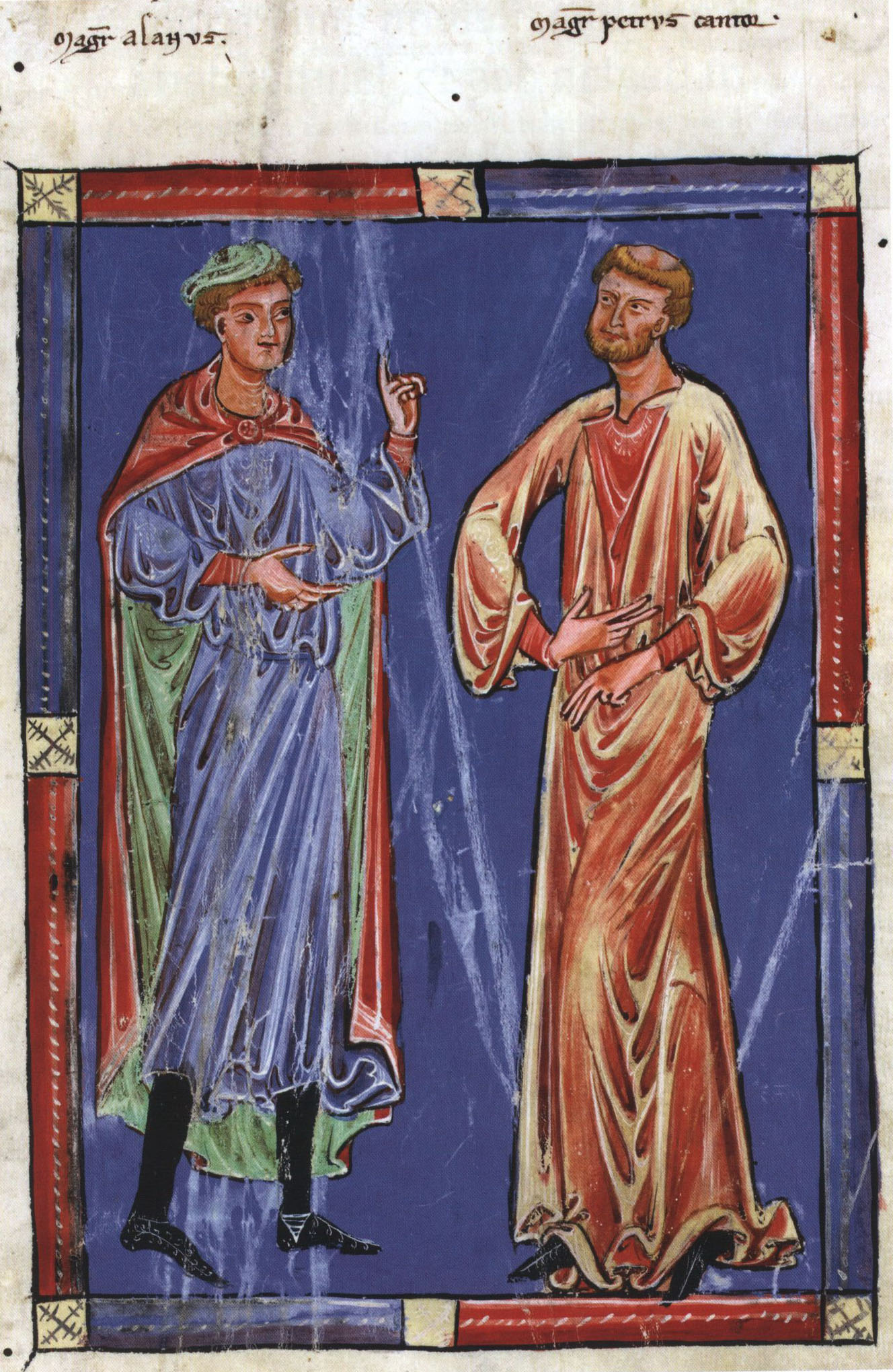
Career: Alan’s career spans the scholastic and monastic worlds. As a secular master in Paris, he produced works that display incredible erudition in theology, philosophy, and classical learning. His principal works include: De Planctu Naturae (discussed above) and Anticlaudianus, both allegorical poems combining prose and verse (www.newadvent.org). He also wrote important prose treatises – notably the Ars fidei catholicae (Art of the Catholic Faith) dedicated to Pope Clement III (www.newadvent.org), a systematic refutation of Jews, Muslims, and heretics by rational argument. Alongside that, he penned the Tractatus contra hereticos and Theologicae regulae (www.newadvent.org), which were aimed at confronting the heterodox movements (his works show awareness of doctrines of the Cathars, Waldensians, and other dissident groups). In the realm of philosophy, Alan compiled a sort of theological dictionary of synonyms (Liber parabolarum or Liber distinctionum), and a Liber poenitentionalis (on penance) (www.persee.fr). He even attempted a commentary on the Song of Songs (Elucidatio in Cantica Canticorum) in an allegorical vein (www.documentacatholicaomnia.eu). His teaching career made him contemporaries with John of Salisbury (who mentions Alan) (handwiki.org) and perhaps Peter Abelard’s later years. After joining the Cistercians, Alan’s output seems to diminish – possibly he shifted to more contemplative writing. Some scholars believe he might have composed a Liber Monasteriorum (now lost) or other sermons at Cîteaux. Alan’s intellectual influences were broad: he was clearly influenced by Plato (via Macrobius and the School of Chartres) and Aristotle (he knew Aristotle’s logic through Boethius’s translations) (www.newadvent.org). He also absorbed the mystical tendencies of Pseudo-Dionysius and Eriugena (www.newadvent.org), which is seen in the mystical strains of his allegories. In summary, Alan’s career produced a corpus that straddles genres – from didactic poetry and satire to scholastic theology – reflecting the eclectic spirit of the 12th-century Renaissance.
Historical Context: Alan lived during the twelfth-century flowering of learning and also amid significant Church controversies. He was a younger contemporary of Saint Bernard of Clairvaux (who died 1153) and Peter Abelard (d. 1142), inheriting the aftermath of their disputes over reason and faith. The Plantagenet empire and Capetian France were the political backdrop of his life – indeed, recent research posits Alan had connections to Thomas Becket’s circle in England (journals.openedition.org) (journals.openedition.org). Carla Rossi’s study suggests that Master Alan might have spent time in the entourage of Thomas Becket (the Archbishop of Canterbury martyred in 1170) (journals.openedition.org), and that Alan’s later entering of Cîteaux could even be linked to exile after Becket’s death (this is speculative but intriguing). What is certain is that Alan was deeply involved in the intellectual debates of his day: he wrote against the Cathar heresy at a time when the Church was escalating efforts to condemn and combat heretics (the Albigensian Crusade followed shortly after his death). He also participated in the broader scholastic project of reconciling reason with faith. Alan’s rationalist streak – claiming that many truths about the world can be known by reason alone, with faith needed for higher mysteries (www.newadvent.org) (www.newadvent.org) – situates him among thinkers pushing the frontiers of theology in a more philosophical direction (a path that would continue with Aquinas a century later). Contemporary figures include Gilbert de Poitiers, John of Salisbury, William of Conches – all part of the Chartres/Paris scholarly network. Later medieval writers often mention “Alanus” with respect, and Dante Alighieri even puts an “Alanus” (likely Alan of Lille) in the Heaven of the Sun among great doctors of the Church in the Divine Comedy.
Legacy: Alan of Lille’s legacy is twofold: as a theologian and as a poet-allegorist. In theology, he is remembered for his attempt to systematically refute heresy and unbelief using logic – his Contra Haereticos (also known as De Fide Catholica) became a reference for later medieval heresiologists (www.newadvent.org). He was sometimes cited by scholastics of the 13th century (though the triumph of Aquinas and others overshadowed Alan’s more verbose style). Within the Cistercian tradition, Alan is honored as a distinguished member – some monastic chronicles list him as an illustrious convert-monk. In literature, Alan’s influence, as noted, was profound through De Planctu Naturae and Anticlaudianus. These works kept Alan’s name alive among poets—Jean de Meun, Gower, Chaucer, and others ensured that the “Universal Doctor” would be remembered as a master of allegory (sourcebooks.web.fordham.edu) (www.arlima.net). For modern scholars, Alan of Lille is a key figure representing the peak of 12th-century humanism: he synthesized Biblical thought, classical learning, and creative imagination in a way few others did. His phrase “Omnis mundi creatura quasi liber et pictura, nobis est in speculum” (“Every creature of the world, as a book and a picture, is to us a mirror”) became famous as an expression of medieval symbolic worldview – often quoted in studies of medieval philosophy and cosmology. Today, Alan’s lasting significance lies in his role as a bridge: he connected the age of Bernard and Hildegard with the age of Aquinas and Dante. Though not a household name like Augustine or Aquinas, Alan of Lille is still esteemed by historians as one of the great minds of the 12th century, a polymath who left an indelible mark on the intellectual landscape of the Middle Ages (www.newadvent.org) (sourcebooks.web.fordham.edu).
Side by side view works best on larger screens. Use the toggle above to view Latin or English separately.
Text & Translation Information
Watch this translation on YouTube
Listen to the Latin with English translation and leave your thoughts in the comments.
Watch on YouTube