
De Octo Vitiis (c. 600 CE)
A 6th-century monastic treatise systematically analyzing eight principal vices that corrupt the spiritual life, drawing on earlier desert fathers' wisdom to guide monastic communities in moral formation. This work represents an important link in the transmission of Eastern ascetic tradition to Visigothic Spain during Christianity's consolidation in Iberia.
Historical Context
Authorship: The treatise De Octo Vitiis (“On the Eight Vices”) is traditionally ascribed to Eutropius of Valencia, a Spanish monk and later bishop. This attribution is generally accepted by scholars. Both St. Isidore of Seville and St. Ildefonsus of Toledo refer to Eutropius and his writings, confirming his authorship (catholicism.en-academic.com). Isidore even recommended one of Eutropius’s letters as edifying reading for all monks (catholicism.en-academic.com). There is no indication the work is pseudonymous; on the contrary, it fits what we know of Eutropius’s life and monastic concerns. (Some reference works in the past mistakenly placed Eutropius around the 4th century (www.fourthcentury.com), but modern consensus based on Spanish sources like Enrique Flórez corrects this to the late 6th century (catholicism.en-academic.com).)
Date of Composition: De Octo Vitiis was likely written in the 580s, while Eutropius was abbot of a monastery, before he became bishop in 589 (catholicism.en-academic.com). Internal evidence and patristic influences (notably John Cassian) point to a late 6th-century context. Eutropius flourished during the Visigothic kingdom’s transition from Arianism to Catholicism. His death is recorded circa 610 (catholicism.en-academic.com). Thus, the treatise’s composition is typically dated to the late 6th century, shortly before 589, in the final decades of Visigothic Arian rule.
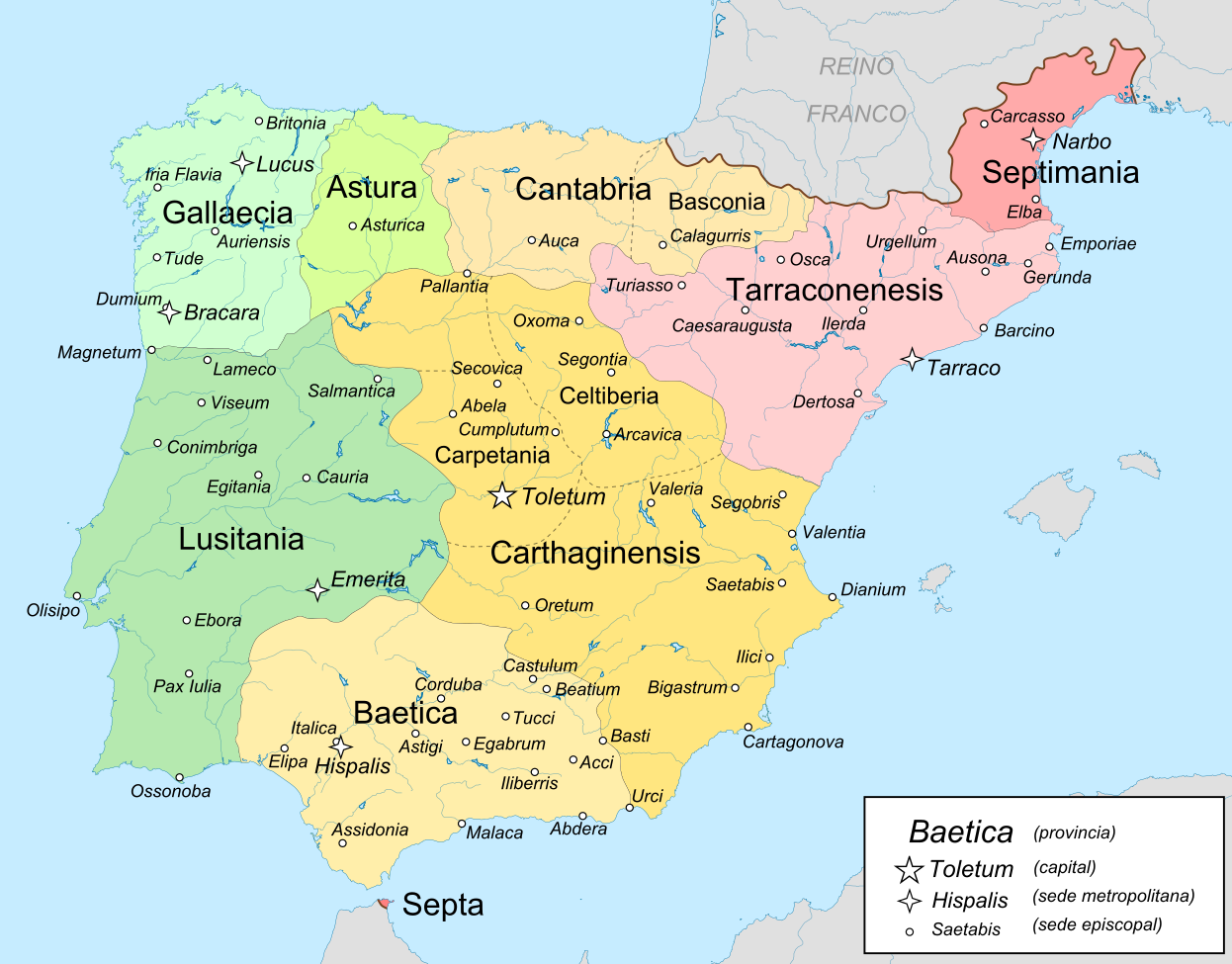
Provenance: The work was composed in Hispania (Visigothic Spain), specifically in the province of Valencia. Eutropius was originally a monk of the Monasterium Servitanum, a monastery in the Valencian region (catholicism.en-academic.com). This monastery had been founded by a monk named Donatus, a refugee from Vandal North Africa, and followed an ascetic rule derived from African monastic traditions (catholicism.en-academic.com). Eutropius succeeded Donatus as abbot of Servitanum (catholicism.en-academic.com), and it was under these monastic conditions that he wrote his letters. The immediate setting was a monastic community concerned with discipline and spiritual purity. We know Eutropius corresponded with other churchmen: one letter was addressed to Licinianus, Bishop of Cartagena, and others to Peter, Bishop of Iturbica, indicating a network of Iberian clergy engaged in theological queries (www.newadvent.org). Thus, the treatise likely originated as an abbatial letter in a monastic milieu in or near Valencia.
Historical Setting: De Octo Vitiis was written during a pivotal era in Visigothic Spain. Politically, the Iberian peninsula was ruled by the Visigothic Kingdom. Culturally and religiously it was a time of reconciliation between the formerly Arian Visigothic elites and the Nicene (Catholic) majority of Hispano-Roman population. In 589 King Reccared I converted from Arianism to orthodox Catholicism, culminating in the Third Council of Toledo (catholicism.en-academic.com). This was a watershed moment that unified church authority and doctrine in the kingdom. Eutropius himself took part in this Catholic ascendency: “It was not till 589 that he became Bishop of Valencia,” notes one source (catholicism.en-academic.com), implying he likely attended or was appointed around the time of the 589 council. The late 6th century also saw intensive ecclesiastical activity – bishops like Leander of Seville and later Isidore were reforming the Spanish Church and combating remnants of heresy. Monastic life was on the rise too, influenced by Eastern asceticism and North African émigrés. Eutropius’s monastery, founded by an exiled African monk, reflects the cross-Mediterranean influences at play (catholicism.en-academic.com). In writing about the “eight vices,” Eutropius was addressing issues of spiritual discipline highly relevant in an age focused on strengthening Christian morals after the compromises of Arian rule.
License: Creative Commons Attribution-ShareAlike 3.0 Unported
Intended Audience: The original audience for De Octo Vitiis was primarily monastic. The text is framed as an epistle to a fellow bishop (bishop Peter of Iturbica), but Isidore of Seville records that Eutropius intended its teachings for the edification of monks in general (catholicism.en-academic.com). In one letter, Eutropius explicitly states that numbers matter less than fervor in a monastery – a message likely aimed at his own monks and other ascetics (alchetron.com). The treatise systematically describes the principal vices that “afflict the human race,” suggesting it functioned as a didactic guide for moral correction in the cloister (la.wikisource.org). Why was it written? The context implies a pastoral concern: Eutropius wished to warn and instruct monks about the major spiritual dangers (gluttony, lust, etc.) that could lead to the “destruction of monks and ruin of monasteries” (the title given to one of his letters) (alchetron.com). It may have been prompted by specific issues in his community – perhaps laxity or misunderstanding about sin – but it clearly had a wider didactic purpose. By circulating it to a fellow bishop, Eutropius sought to share this monastic wisdom more broadly. In summary, the treatise was written by an abbot for monks, to bolster ascetic discipline and spiritual vigilance in a time of religious renewal.
Theological Significance
Core Themes: De Octo Vitiis is a treatise on moral theology and ascetic spirituality. Its core theme is the classification and conquest of the eight principal vices that “attack the human race” (la.wikisource.org). Eutropius systematically enumerates these eight chief vices or passions: gluttony (gastrimargia), lust (fornicatio), avarice (philargyria, “love of money”), anger (ira), sadness or melancholy (tristitia), acedia (spiritual sloth or despondency), vainglory (cenodoxia), and pride (superbia) (catholicism.en-academic.com). He describes how these vices are interrelated in a kind of chain or “concatenation,” where one leads to the next (la.wikisource.org). For example, excess in gluttony gives rise to lust; unchecked sadness can slip into acedia, and so on (la.wikisource.org). A major emphasis is on the internal spiritual warfare against these passions. Eutropius analyzes each vice’s origin and effects on the soul (catholicism.en-academic.com), warning how they “infest” and ultimately destroy the spiritual life if not resisted. The antidote, he argues, is a life of earnest discipline supported by divine grace: a Christian must strive with all his strength against these enemies, yet remain humble, knowing that victory comes only with God’s help (catholicism.en-academic.com). In essence, the treatise’s intellectual aim is to map out the pathology of sin in the soul and prescribe a remedy of vigilance, self-denial, and reliance on grace (catholicism.en-academic.com).

License: Public domain (photograph of a 15th-century artwork)
Patristic Context: Eutropius stands in continuity with earlier Church Fathers’ teachings on moral vices, especially the ascetic tradition of the East. In particular, his schema of eight principal faults is drawn directly from Evagrius Ponticus and John Cassian. Cassian (c. 360–435) had famously enumerated the same eight vitia principalia in his monastic writings (www.catholicculture.org) (www.catholic.com), and Eutropius explicitly follows Cassian’s list and logic. As he develops each point, “the teaching of Cassian becomes more and more evident,” one modern source observes (catholicism.en-academic.com). For example, Eutropius, like Cassian, correlates the vices with the “seven nations” of Canaan in Scripture, using the allegory that just as Israel faced seven nations, the monk faces eight passions – vices “more numerous than virtues” which must be utterly destroyed with God’s aid (la.wikisource.org) (la.wikisource.org). This biblical analogy is lifted almost verbatim from Conference 5 of Cassian (www.ewtn.com) (www.catholicculture.org). We also see resonance with St. Gregory the Great and other Latin fathers of that era. Notably, Eutropius still teaches eight capital vices, reflecting the older patristic tradition (Evagrius/Cassian). Around the same time (c. 590s), Pope Gregory I was slightly modifying this scheme: finding overlap, Gregory merged vainglory into pride and acedia (“sloth”) into tristitia (“sorrow”), and added envy, yielding the classic list of seven deadly sins (www.catholic.com). Eutropius does not mention envy as a separate category, nor does he collapse any, showing that he operated squarely in the earlier Evagrian framework. His work thus represents the bridge between Eastern monastic teaching and Western medieval doctrine. It is grounded in Scripture (he cites, for instance, Proverbs and Deuteronomy to illustrate spiritual pride and God’s warning to Israel (la.wikisource.org) (la.wikisource.org)) and the Fathers (he invokes the consensus of “Scriptures and the Fathers” on the duty of monastic correction (catholicism.en-academic.com)). We can also detect Augustinian influence indirectly: the strong insistence on divine grace (Eutropius says we cannot overcome these vices by “our own strength” without God (la.wikisource.org)) reflects the anti-Pelagian ethos that pervaded Western theology after Augustine. In summary, De Octo Vitiis is deeply rooted in patristic thought – *Cassian’s monastic psychology above all – and aligns with the mainstream ascetic theology of late antiquity.
Biblical Foundation: The treatise is richly scriptural. Each vice is buttressed by Biblical citations and examples. For instance, Eutropius quotes Sirach 36:20 (“Be not drawn by the belly”) against gluttony and cites St. Paul’s warnings against fornication for lust (la.wikisource.org). He refers to Ephesians 4:26–27 (“let not the sun go down on your anger… give no opportunity to the devil”) in discussing anger (orthodoxchurchfathers.com). A striking example is his use of the Old Testament: he interprets the seven Canaanite nations which Israel had to conquer (Deuteronomy 7, etc.) as figures of the principal vices (la.wikisource.org). “These seven nations…we should understand as written for our admonition,” he writes, applying St. Paul’s teaching that Israel’s struggles prefigure our spiritual combat (la.wikisource.org). He even notes that Scripture lists seven nations but says they were “greater in number” than Israel – an allegory that vices are many and prolific (la.wikisource.org). Eutropius explains that in the text the nations are numbered as seven, yet their defeat is described without number, to imply the innumerable assaults of sin (la.wikisource.org). Such exegetical moves show the influence of Origen and Evagrius (who similarly spiritualized the Canaanite nations as passions). Besides Deuteronomy and Proverbs (la.wikisource.org), Eutropius invokes other Scriptures indirectly used by Cassian and other fathers – for example, he alludes to Psalm 91’s “noonday devil” in describing acedia, and to Gospel passages on pride and vainglory (“Whoever exalts himself shall be humbled” etc.). Overall, the work is founded on a biblical moral vision: the vices are the enemies within, analogous to the enemies of God’s people in the Bible, and the monk must fight them with the sword of Scripture.
Controversies: The content of De Octo Vitiis does not appear to have sparked specific doctrinal controversies – it is well within orthodox ascetic teaching. Eutropius is careful to cite Scripture and patristic authority, avoiding any heterodox positions. If anything, one could point to the subtle theological debate on grace and free will: Eutropius heavily emphasizes that human effort alone cannot overcome vice, and that one absolutely requires God’s grace for victory (la.wikisource.org) (la.wikisource.org). This aligns with Catholic teaching (ratified at Orange in 529) against Pelagianism. In his strictness regarding monastic discipline, some contemporaries might have found him harsh – indeed Eutropius acknowledges that he was criticized for severity in enforcing the rule, but he justifies it by citing Scripture’s demand for pastors to correct faults (alchetron.com) (alchetron.com). This aligns with the wider monastic discourse on “compunctive” discipline vs. leniency. There is no hint of any heterodox or extreme position in his theology. If anything, the only “controversy” is a later textual one: in the Middle Ages the treatise was sometimes misattributed (see below), but content-wise it was widely accepted. His classification of sins was later superseded by Gregory’s seven-fold list, yet even that was seen not as a contradiction but a refinement of the same tradition. So while De Octo Vitiis itself did not provoke controversy, it participated in the ongoing development of the doctrine of capital sins (the shift from eight to seven). Modern scholars note this treatise as an important witness to the Western reception of Evagrian spirituality, marking how monastic theology in Spain kept fidelity to the eightfold schema even as Rome moved to seven deadly sins.
Influence: Eutropius’s treatise had a notable if modest influence on later Christian thought, especially in the monastic and penitential literature of the early medieval West. In Visigothic Spain, his ideas were transmitted by figures like Isidore of Seville, who not only praised Eutropius but also incorporated similar moral categorization in his own writings (e.g. Isidore’s Sententiae discuss vices and virtues in a systematic way). Isidore’s esteem for Eutropius – calling one of his letters “a must-read for every monk” (catholicism.en-academic.com) – suggests the text was copied and read in Iberian monastic circles through the 7th century. The work likely informed the moral instruction in Spanish monasteries and possibly influenced Saint Fructuosus of Braga and other monastic legislators of the 7th century (who similarly enumerated vices to avoid). Beyond Spain, the treatise had an echo in the broader Latin West. An interesting sign of its diffusion is that excerpts of De Octo Vitiis were later attributed to St. Columbanus in some manuscripts (sources.nli.ie) (la.wikisource.org). For example, an 11th-century manuscript from Ireland contains a piece “De octo principalibus vitiis” nearly identical in incipit and content to Eutropius’s work, but ascribed to Columbanus (sources.nli.ie). This misattribution suggests that by the High Middle Ages the treatise had entered the general monastic literary tradition, to the point that its true origin was obscured and it was absorbed as part of the body of common ascetic teaching (Columbanus himself wrote similar instructions). Through such transmission, Eutropius’s doctrine of the eight vices helped shape the medieval understanding of the “capital sins.” We can see its legacy in the later manuals of penance and monastic confession: the concept of enumerating principal faults for examination of conscience, a practice prevalent in the Middle Ages, owes much to Cassian and his followers like Eutropius. By the 13th and 14th centuries, the seven-capital-sins schema dominated, but the foundational analysis in works like De Octo Vitiis laid the groundwork. In summary, while Eutropius is not a household name, his treatise served as a conduit of patristic wisdom into the early medieval Latin tradition. It reinforced the lineage from Evagrius and Cassian to later spiritual writers, ensuring that the monastic “eightfold diagnosis” of sin remained a part of Western spiritual teaching until it was eventually systematized into the Seven Deadly Sins by Gregory and later scholastics.
Manuscript Tradition and Editions
Manuscripts: The text of De Octo Vitiis survives in a handful of medieval manuscripts, often transmitted alongside other monastic and penitential writings. Because it was essentially a letter or treatise embedded in the correspondence of Eutropius, it did not form part of a large corpus and so was preserved in scattered copies. One known witness is an 11th-century manuscript that pairs a Vita S. Brendani (Life of St. Brendan) with a text beginning “Octo sunt vitia principalia…” – clearly our treatise (sources.nli.ie). Intriguingly, in this Irish manuscript the work is attributed to “St. Columbanus” (the great Irish monk), demonstrating how Eutropius’s text was copied and repurposed far from its Spanish origin. (The incipit in that manuscript is “Octo sunt vitia principalia vel originalia…”, almost identical to Eutropius’s, confirming it’s the same work (sources.nli.ie).) In Spain, the letters of Eutropius were likely preserved in ecclesiastical archives or compilations of Visigothic church documents. Isidore of Seville (early 7th c.) had access to at least two of Eutropius’s letters (catholicism.en-academic.com), which implies these were copied in Spanish scriptoria. It’s possible that a collection of Spanish monastic letters (now lost) contained Eutropius’s correspondence, which later historians like Ildefonsus of Toledo could consult. By the Carolingian era, extracts of De Octo Vitiis appear in moral anthologies and florilegia. For example, an early medieval treatise on vices and virtues (Etymologiae-derived or Pseudo-Basil rules) might include material from Eutropius, though such influence is hard to tease out since he draws so heavily on Cassian. Nonetheless, the survival of the full text into the high Middle Ages (as evidenced by the Irish copy) shows it had a continuous manuscript tradition, if a sparse one. No original late 6th-century manuscript exists today – our knowledge comes from later copies, likely from the 8th–12th centuries, that kept Eutropius’s letters in circulation in monastic libraries.
Critical Editions: The first published edition of Eutropius’s letters came much later. In the mid-18th century, Spanish scholar Enrique Flórez included Eutropius in his España Sagrada collection, using the manuscripts available in Spain. These letters were subsequently reprinted by J.-P. Migne in Patrologia Latina, Vol. 80 (1850) (la.wikisource.org) (catholicism.en-academic.com). Migne’s text (PL 80, columns 9–20) is based on earlier editorial work and lacks a critical apparatus (la.wikisource.org). It essentially presents De octo vitiis (cols. 9D–14D) and the companion letter De districtione monachorum et ruina monasteriorum (cols. 15A–20A) from a presumably good manuscript source, but without documenting variant readings. As of now, there is no modern critical edition in the Corpus Christianorum or CSEL series. The Patrologia Latina version remains the standard reference, though scholars treat it with caution due to 19th-century editorial practices (Migne sometimes modernized spellings and merged readings). Some minor textual issues have been noted by comparing manuscripts. For instance, the title of the first letter appears as “De districtione monachorum” in Migne (la.wikisource.org) – likely a misreading of destructione (meaning “ruin” or “downfall”). Isidore referred to the letter as “De destructione monachorum et ruina monasteriorum” (www.newadvent.org), which makes more sense contextually; the Migne editor (or an earlier scribe) read it as “districtione” (an archaic term for strictness). Such minor discrepancies in title and wording occur among manuscripts. However, the substance of the text shows remarkably little variation across the few known copies – presumably because it was not a frequently copied or translated work, thus avoiding the heavy interpolation that more popular texts suffered.
Existing Translations: De Octo Vitiis has not had a standalone translation in modern languages until very recently. There is no widely published English translation of Eutropius’s letters. Portions of the Latin text have been translated in scholarly articles or dissertations dealing with early monastic spirituality, but as of now a full English (or French/German) translation remains a scholarly desideratum. (One might find an informal English rendering of the Eight Vices section in comparative studies of Cassian, but it’s not in general circulation.) The treatise is occasionally included in discussions of the seven deadly sins, and modern authors sometimes paraphrase Eutropius’s insights in English (www.catholic.com) (www.catholic.com). For Latin readers, the text is accessible online (e.g. on Wikisource and document collections). In Spanish, a summary or partial translation can be found in some historical works about Visigothic monasticism, but a full Spanish translation is not commonly published either. In short, De Octo Vitiis remains primarily in its original Latin in academic use.
Textual Issues: The text of De Octo Vitiis is straightforward and short, so it has not posed major textual problems. The main letter (on the Eight Vices) runs only a few pages. There are a few variant readings in terms of the names of the vices: for example, some copies list cupiditas (cupidity) instead of the Greek loanword philargyria for avarice (la.wikisource.org), or use vanagloria in place of cenodoxia for vainglory – these reflect scribes updating terminology. One manuscript adds the qualifier “vel originalia” (“or originating [vices]”) after “principalia” in the incipit (sources.nli.ie), aligning the phrase with Cassian’s description of these as root sins. Overall, such variants do not change the meaning. The structure and content across the known manuscripts are consistent, indicating a stable transmission. As noted, confusion over the title of the first letter (destructione vs. districtione) is one noteworthy issue, likely arising from a scribal slip – modern scholars concur the letter addresses the “downfall” or destruction of monks, not “discretion” (www.newadvent.org) (la.wikisource.org). In summary, while De Octo Vitiis has not benefited from a modern critical edition, the available text is serviceable and shows a cohesive doctrinal message in all sources. Future discovery of new manuscript witnesses in Spanish archives could further confirm the text, but none of the currently known variants significantly alter Eutropius’s teachings on the eight vices.
Author Biography
Life: Eutropius of Valencia (d. circa 610) was a late 6th-century cleric who rose from monastic life to the episcopate. Little is recorded of his early life – even his birth date or origin is unknown, though by his name (Greek-derived, meaning “well-nourished”) and sphere of activity he was likely a Romanized Spaniard. He entered the monastic life as a young man and became a disciple of Donatus, a monk from North Africa (catholicism.en-academic.com). Donatus had fled the Vandal persecutions (mid-5th century) and founded the Monasterium Servitanum in the province of Valencia, in southeastern Spain (catholicism.en-academic.com). Eutropius joined this community and eventually succeeded Donatus as Abbot of Servitanum (catholicism.en-academic.com). As abbot, Eutropius was known for his rigorous observance and strict discipline. His contemporary St. Isidore remarks that Eutropius could be criticized for severity, “but he easily justifies himself, for his only care is enforcing the founders’ rules” (alchetron.com). Indeed, Eutropius took his role as spiritual father seriously, correcting laxity in his monks even if it earned him reproach (alchetron.com).
During his abbacy, Eutropius authored at least three letters of doctrinal importance. One letter, now lost, was to Licinianus, Bishop of Cartagena, inquiring about the liturgical practice of anointing baptized infants with chrism (www.newadvent.org). Another two letters were addressed to Peter, Bishop of Iturbica (a diocese in Visigothic Spain). The first to Peter, titled “De destructione monachorum et ruina monasteriorum” (“On the Destruction of Monks and the Ruin of Monasteries”), survives and contains Eutropius’s counsel on maintaining zeal in monastic life (www.newadvent.org). In it, he emphasizes that the number of monks matters less than their fervor, and he defends the strict enforcement of discipline, citing Scripture and monastic tradition (alchetron.com) (alchetron.com). The second letter to Peter is De octo vitiis – the treatise on the Eight Vices which we have been discussing at length. These writings show Eutropius to be learned in Scripture and patristics, and deeply concerned with the spiritual health of the Church. Isidore of Seville, who was a younger contemporary, held Eutropius in high esteem and specifically praised his letters, indicating their impact in Spanish ecclesiastical circles (catholicism.en-academic.com).
In 589, a major turning point came: at the Third Council of Toledo, King Reccared and the Visigothic nobility converted from Arianism to Catholicism. It was around this time that Eutropius was elevated to the rank of Bishop of Valencia (catholicism.en-academic.com). Sources note “it was not till 589 that he became Bishop of Valencia” (catholicism.en-academic.com), implying that with the Gothic conversion, Catholic bishops were appointed to formerly Arian-held sees. We can surmise Eutropius, as a respected abbot in the region, was chosen to lead the diocese of Valentia (Valencia) when orthodox hierarchy was restored. He likely attended the Third Council of Toledo in 589 in person, alongside luminaries like St. Leander of Seville. As bishop, however, Eutropius’s activities are scarcely recorded. “Nothing is known of his work during his episcopacy,” writes one historian (catholicism.en-academic.com). This is not unusual, as ecclesiastical chronicles of that era are patchy. We do know he held the see until his death, which occurred sometime after 610 (historians place his death “not earlier than 610”) (catholicism.en-academic.com). By the time of his passing, Eutropius would have seen the Visigothic Kingdom firmly entrenched in Catholic orthodoxy and perhaps played a part in organizing local councils or implementing the canons of Toledo in his diocese.
Career: Eutropius’s career trajectory is emblematic of 6th-century Spanish churchmen. Monk first and foremost, he spent probably decades in ascetic life. Under Donatus’s tutelage, he absorbed a blend of African and Eastern monastic wisdom (the rule at Servitanum was said to be based on St. Augustine’s or African monastic practices) (catholicism.en-academic.com). As Abbot, he emerged as a local authority on spiritual matters, which led other bishops to consult him (hence Licinianus of Cartagena seeking his input on baptismal chrismation) (www.newadvent.org). His writings – though few – reveal an intellectual influence from outside Iberia: he references Cassian (from Gaul/East) and follows broad Catholic tradition. Upon becoming Bishop of Valencia, Eutropius joined the ranks of the visigothic episcopate during an era of church consolidation. He likely had to regularize his diocese after decades of Arian domination, catechize former Arians, and strengthen orthodox practice. Given Valencia’s importance as a Mediterranean city, he may have also dealt with the lingering Byzantine presence in southeast Spain (the Byzantines still held parts of the coast until c. 625). We have no record of him in subsequent councils (the next big one was Fourth Council of Toledo in 633, by which time he was presumably deceased). Aside from his letters, no other works by Eutropius are known. His intellectual influences include St. Augustine and St. Jerome indirectly (through the African rule and Isidore’s citations), but most clearly John Cassian and the desert father tradition.
Historical Context: Eutropius lived under Visigothic kings like Leovigild (r. 568–586) and Reccared (r. 586–601). He experienced the dramatic shift of 589 when the Visigothic kingdom became officially Catholic. Contemporary figures in his circle would include Leander of Seville (who presided at Toledo III), Masona of Mérida, and later Isidore of Seville – all leaders of the new united Spanish Church. Theologically, the main controversy of his early career was Arianism vs. Nicene faith; by the time he was bishop, that had been resolved in favor of Catholicism. Another issue of the day was the integration of Gothic and Hispano-Roman ecclesiastical structures – Eutropius as a Roman monk becoming a bishop in a Gothic kingdom is a case in point of that integration. He also lived through the wars against the Byzantine enclaves in Spain and the ongoing missionary efforts to rural pagans or semi-Arians. Within the Church, there were local disciplinary challenges – many councils of the period deal with clerical celibacy, simony, and moral laxity. Eutropius’s insistence on monastic discipline can be read against that backdrop of ensuring high moral standards in a recovering Church. We find no evidence that he was involved in political machinations or secular office (unlike some bishops of the time). He appears as an exemplar of the “bishop-monk”, dedicating himself to spiritual guidance.
Legacy: Eutropius was revered by the generation after him. St. Isidore, writing in the early 7th century, praises Eutropius as a man of learning and sanctity, and clearly had access to his writings (catholicism.en-academic.com). Later Spanish tradition regarded Eutropius as a saint, at least honorifically. The Catholic Encyclopedia notes that “historians have usually called him Saint, though it doesn’t appear he was ever honored by a liturgical cult” (catholicism.en-academic.com). In other words, he was venerated in memory for his holy life, but there is no record of an official feast day or widespread devotion. His name does not appear in standard martyrologies, likely because the Visigothic local calendars did not survive or because his cult was overshadowed by others. However, his influence lived on through his monastery (Servitanum) and his letters. Monks in Iberia for generations would read his letter on monastic ruin as a cautionary tract – Isidore explicitly recommended it for all monks (catholicism.en-academic.com). In the longer view of history, Eutropius’s legacy is tied to the doctrine of the capital sins. As one link in the chain from Evagrius to Gregory the Great, Eutropius helped transmit the eightfold schema to the Western monastic context. Modern scholars of spirituality acknowledge him when tracing the evolution of the Seven Deadly Sins doctrine (www.catholic.com). Locally, the Diocese of Valencia remembers him as an early bishop who helped establish orthodoxy after the Gothic conversion. Even beyond Spain, the survival of his treatise under Columbanus’s name indicates that his teaching became part of the common monastic heritage. Today, Eutropius is a somewhat obscure figure, but within the field of patristics and medieval studies he is recognized as Valencia’s learned ascetic bishop. His lasting significance lies in exemplifying the fusion of African monastic rigor with Spanish pastoral care – a fusion that helped shape Visigothic Christianity. In sum, Eutropius is remembered as a monastic reformer and moral teacher, whose succinct treatise on the eight vices continued to edify the Christian conscience well into the Middle Ages.
Side by side view works best on larger screens. Use the toggle above to view Latin or English separately.
Text & Translation Information
Watch this translation on YouTube
Listen to the Latin with English translation and leave your thoughts in the comments.
Watch on YouTube